
A Guide to the Full-Day Offshore Charter: Be the Client the Mate Wants to See Again
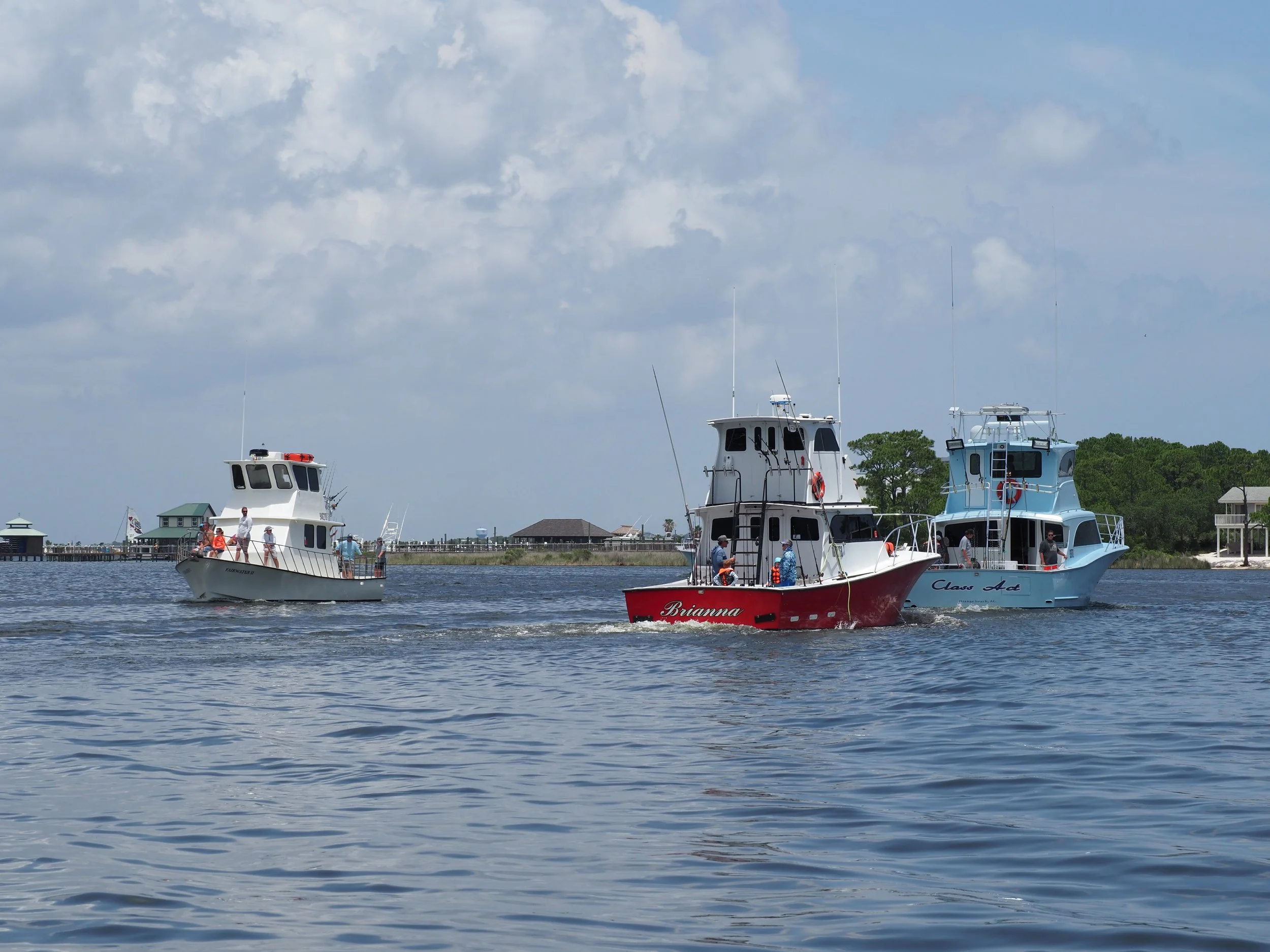
Charter boats heading out of Zeke’s Landing
It's 5:30 AM at Zeke's Landing. The sportfisher is at the slip, already idling, the mate on the deck rigging baits with the practiced economy of somebody who's done this five thousand times. The captain's up on the bridge, scrolling charts, watching the wind. The cabin lights are on. The coffee in the galley is hot. Your eight-hour day is about to start with you climbing the gunwale and end at four in the afternoon with a cooler of red snapper and a sunburn you'll feel for a week.
This is the full-day offshore charter — the bucket-list trip on this coast. Eight hours through Perdido Pass and into the Gulf, onto the artificial reefs that earned Alabama the title of red snapper capital of the world. (The same pass our Lost Key Captain's Log walked through — though that one was about coming home; this one's about going out.) The fish you save up to catch. The day your kid will tell stories about thirty years from now.
First, Why Charter at All? You've Got a Boat.
Here's a question I get a lot, and it's a fair one: you've got a boat in the lift — why pay somebody to take you out on theirs? I do it myself a few times a year, usually when friends are coming into town, and the reason is simple. If I'm running the boat, I'm not visiting with my friends. If I'm running the boat, I'm not fishing over the side alongside them. If I'm running the boat, I'm up there worrying about whether I can get them on fish — and the truth is I'm not on the water every single day the way a working charter captain is.
That's the whole case, right there. A professional runs that water daily. He knows the weather, the wind, the tides, where the fish moved to last week, and the private numbers he's spent years marking and won't hand to anybody. He'll handle the boat, the bait, and the box — so you can handle the part that actually matters, which is the people you brought with you. Some days the best seat on the boat is the one where you're not the one driving.
For somewhere between $1,800 and $3,500 — depending on boat size, season, and how far you're running — you're getting a sportfisher with a full crew, top-shelf tackle, the bait the mate caught yesterday, fuel for a sixty-mile round trip, ice for the box, the captain's five thousand trips of accumulated reef knowledge, and the fish cleaning at the end. What you bring is everything else: yourself, your group, your snacks, your Dramamine, and a respect for the difference between this and the half-day inshore.
The unwritten rules of the full-day offshore overlap with the half-day's — and with the rules of being a good guest on anybody's boat, which we covered in an earlier Docklines piece — but they're not the same. The boat is bigger. The crew is two or three. The mate works for tips. Sea sickness is real. The fish cleaning is a separate transaction. And the day, even when the box doesn't fill, is the kind that's measured in years.
1. Make the phone call. Before you book.
Even more critical for offshore than inshore. Discuss target species — red snapper, AJs, triggers, vermilion, kings, mahi, wahoo — because the trip structure is wildly different for reef fishing versus pelagic trolling. Discuss departure time (5:30 AM is typical for full day). Discuss what's actually included — fuel charge separate or rolled in, cleaning included or for a fee, lunch on board or BYO, alcohol on board or not. Discuss the realistic season. We laid the dates out in our Open Seasons piece: this year the federal for-hire (charter) season opened June 1 and runs through October 26, while state-licensed boats follow Alabama's state season, which opened May 22 and is running seven days a week. Outside those windows, the day looks different.
The captain wants to know who he's taking out before the boat ever leaves the slip. A five-minute phone call is how he plans the trip. Skip it and you're rolling up at 5:30 AM with assumptions and no captain to validate them. (TIP: Make sure your guests have any medications they may need and you know if there are any medical conditions.)
2. Show up early. Show up ready for eight hours.
Not four. Eight. That changes the prep.
Sunscreen on before you board, plus a tube to reapply at noon. A real hat — not a ball cap, a hat with a brim. Polarized sunglasses on a leash. Layers — a 70-degree dawn at thirty knots running through Perdido Pass is cold no matter what month it is. Substantial food, not just snacks, unless the boat provides; you're eating breakfast and lunch on the water. Plenty of water. A spare shirt for the ride home. Closed-toe non-marking shoes.
And Dramamine. Pre-dose the night before, plus another with breakfast. (More on that below.)
3. Listen to the briefing.
The pre-departure briefing on a sportfisher is longer and more important than on an inshore skiff. Where the head is. How to flush it (no, you cannot put paper in the marine head on most boats). Where the safety gear is. What to do if a fish breaks the surface. What the mate wants you to do when he says fish on. What to do with a hot rod when the fight ends. Where to stand. Where not to stand. What the all hands on deck call sounds like.
The mate has run this briefing eight thousand times. Listen all the way through. Ask the question if something isn't clear. The first ten minutes of the day is the difference between a clean trip and a chaotic one.
4. The captain runs the boat. The mate runs the deck. You fish.
On a sportfisher, the division of labor is clean. The captain is on the bridge — reading the bottom, watching radar, picking the spots, checking weather. He may not say much for hours; that's not a personality flaw, that's the job. The mate is on the deck — rigging baits, taking fish off, untangling lines, gaffing, coaching, refreshing tackle. You are the angler.
Don't tell the captain where to go. Don't tell the mate how to rig. Don't pull out your phone and show them a YouTube spot you saw last night. You hired professionals. Let them be professional. The captain has run that piece of bottom three hundred times. He doesn't need your suggestion.
5. Sea sickness is real. Manage it before it manages you.
Take Dramamine the night before. Take it again with breakfast. If you wait until you feel sick to take it, you've waited too long.
Let me tell you about John. Years back I helped run a corporate outing — a reward trip for the employees — and aboard was an older gentleman named John. The day turned on us: choppy, windy, humid, the exact kind of slop that hunts down the one man on the boat who didn't take anything that morning. It found John. He went flat on the deck, and we did what you do — shade, wet towels, water, a steady hand. Now John was a glass-half-full sort of fella his whole life, but somewhere out there the glass tipped clean over. By the time we were running in, he'd gone quiet and started handing us messages to carry home to his sweet wife — what to tell her, where to find things, the whole farewell. He was dead certain he was not seeing the dock again.
He saw the dock again. He was back at work Monday, glass half full, telling the story on himself by Wednesday. But I've never forgotten his face, because here's the truth about sea sickness: it's rarely as serious as it feels — and it feels plenty serious when you're laid out on the deck and you know the dock is two hours away. That's the whole reason you take the Dramamine before you need it, not after. Don't be John, dictating his last wishes over a cooler of perfectly good bait.
If you do get sick despite the prep — and good people do, on bad sea days — get to the rail, downwind side, and let it go in the water. Do not try to make it to the head. Do not throw up in the sink, the trash can, or the cooler. The mate has seen it all. He won't laugh. He'll get you a wet towel and a Coke and tell you you'll feel better in twenty minutes, and most of the time you will.
The shame is not in being sick. The shame is in not preparing for the possibility.
6. Tip the mate. Twenty percent. Cash. Hand to him.
This is the rule most different from the inshore charter. On a sportfisher, the mate works for tips. The captain has been paid by the trip fee — he owns the boat, or he works for the boat owner. The mate is working that day, in part or in whole, for the cash you hand him at the end.
The math: $2,500 charter, $500 mate tip is standard. $600 if he hustled. $750 if he kept finding fish when the bite slowed at 1 PM and most days would have been over.
Cash. Directly to the mate. Hand to hand, eye contact, a thank-you. (The Hull Truth has been writing this same thread for fifteen years, and the consensus has not budged: don't put it on the credit card, don't hand it to the captain to split, don't drop it in a jar. Hand it to the mate.)
If the captain ran the boat and mated himself — rare on a true sportfisher, common on smaller offshore boats — the whole tip is his. If the captain owns the boat and clearly went above and beyond — stayed late, ran an extra fifteen miles to find you a fish, taught your kid how to set a hook — toss him an additional $100 in cash separately, on the bridge, with a "this one's for you, captain. Thank you."
The fish cleaning at the dock is usually a separate person — the fish house attendant. Tip that person too. $20 to $40 depending on the cleaning load. They're the last people you'll see at the end of an eight-hour day, and they're the ones turning your snapper into fillets you can walk straight up the dock to a Cook Your Catch kitchen. Worth every dollar.
FROM THE HELM — Thomas Toombs
Here's the part nobody tells you on the way out: the day isn't over when you tie up. You're standing on the dock with a cooler of fillets and no good reason to cook them yourself. So don't. At Zeke's, the same dock crew that just cleaned your snapper is fifty feet from a kitchen that'll cook it — they call it Hook and Cook, and there's no better way to eat a fish than at a table looking at the water it came out of. Down the ICW, LuLu's runs Cook Your Catch; Cobalt and Shipp's will do the same; and Tacky Jacks will fry it golden while the kids fall apart at the table next to you. Bring it cleaned, bring it cold, call ahead, and tell them how you want it — grilled, blackened, or fried. Then sit down. You earned the chair.
7. Limits are limits. Don't ask the captain to bend them.
Two red snapper per person. Sixteen-inch minimum. Captain and mate are not allowed to keep their own snapper when they're carrying paying anglers.
When the box is full on snapper, the box is full. The captain will ask if you want to keep fishing for triggers, beeliners, AJs, kings — almost always yes, and often the day's best species shows up after limits. But don't ask the captain to bend a federal rule for you. He'll lose his license for it. You'll lose the trip. He's run too many years not to know exactly where the line is.
8. Every trip doesn't provide fish. Every trip provides memories.
Same rule as the half-day inshore. More true offshore.
The Gulf has weather days. Wind days. Current days. The reef you booked for might be fishless on the morning you show up — bait moved off it overnight, predators followed, the whole structure shut down for reasons nobody on the bridge or the deck will fully understand. The captain has seen it before. He'll work the day until the last legal minute. He'll try the spots that haven't been fishing. He'll mark something on the bottom and run an extra fifteen miles to give you a shot. That's the captain doing his job, even when the cooler doesn't fill.
Tip the mate twenty percent anyway. Tip him twenty-five if he stayed positive when the day didn't. Book the trip again next year. The good crews on this coast are the ones whose clients come back the season after the slow trip — because the slow trip was still the day the kid saw the sun come up over the Pass for the first time, and the slow trip was still the day a pod of dolphin escorted you home for two miles, and the slow trip was still a day on a boat your family could not have made happen on its own.
That's the deal. That's always been the deal.
The whole point is this: the full-day offshore is not a trip. It's an event. The kind of day people on this coast plan their summer around. The kind of trip a kid talks about thirty years later when she tells her own kids about the first time she saw the sun come up over Perdido Pass and a captain she'd just met handed her a rod that bent in half before she could ask what was on the other end.
The crew makes that day. The mate runs the deck. The captain makes the call. Your job is to be the client they remember — the one who showed up ready, listened to the briefing, fished hard, tipped fair, and shook hands at the dock with a "we'll be back."