
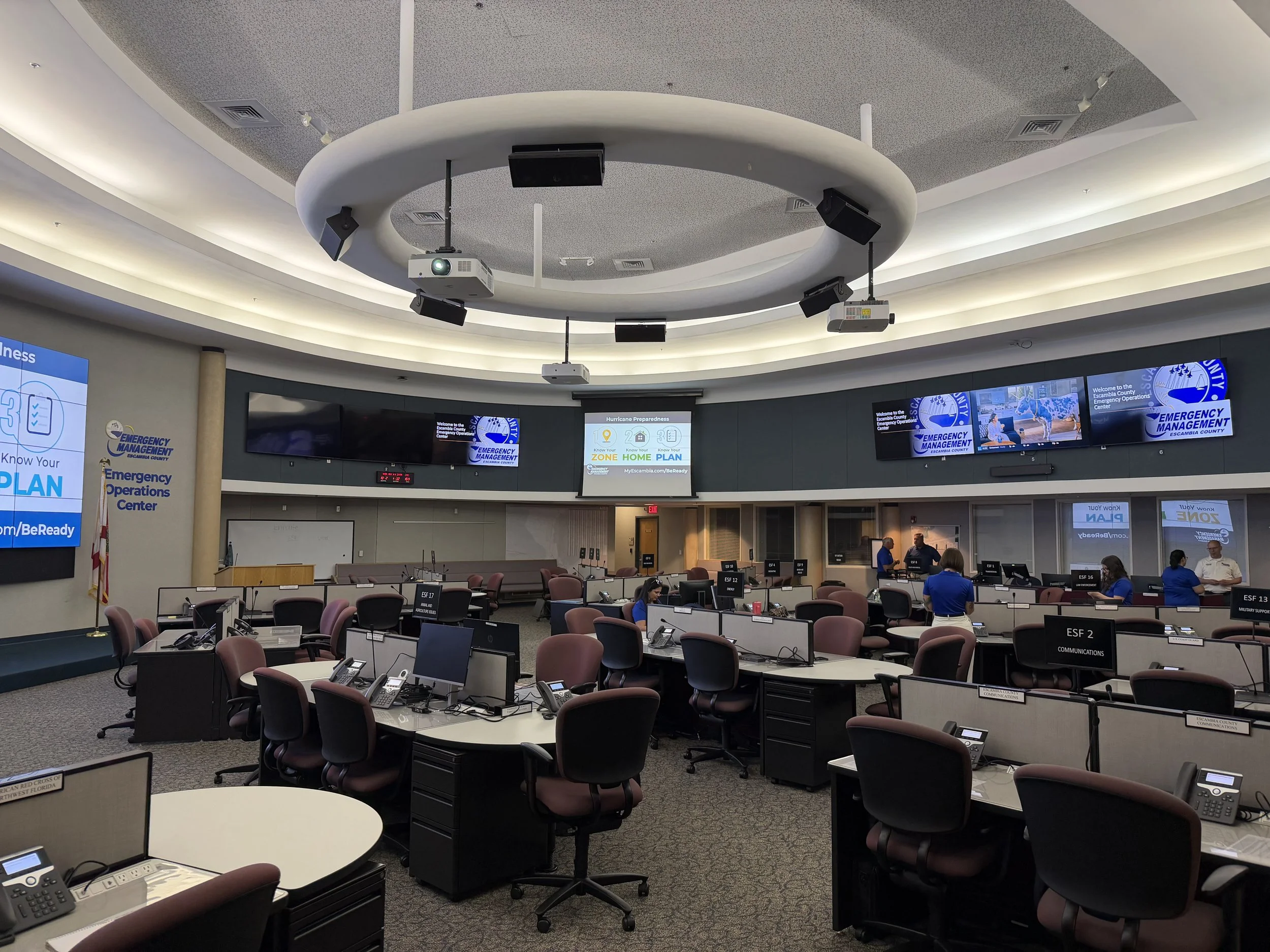
The Control Room to coordinate all local agencies during a crisis - Escambia County Division of Emergency Management
September 10 is the date circled on every hurricane chart on the Gulf Coast — the climatological peak of the Atlantic season, the day the basin is, on average, at its busiest. This year the Gulf is flat. A super El Niño in the Pacific is driving strong upper-level winds out owest across the Caribbean and the tropical Atlantic, and that shear has been tearing storms apart before they can organize. The season has produced five named storms and not a single hurricane — by one measure of storm energy, the most tranquil start since 1941. Quiet is not the same as over. The season runs through November 30, and Colorado State's lead forecaster, Phil Klotzbach, still expects at least one hurricane before it's done.
Anyone who has lived here long enough knows the peak is a statistic, not a promise. Hurricane Ivan came ashore just west of Gulf Shores at 1:50 in the morning on September 16, 2004 — a Category 3 with 120 mph winds that pushed nearly 13 feet of surge into Escambia Bay, destroyed a section of the I-10 bridge and did an estimated $14 billion in damage. Sixteen years later to the day, Hurricane Sally made landfall in the same town as a Category 2, crawling ashore at less than 5 mph and dumping nearly 30 inches of rain on Orange Beach. Part of the Three Mile Bridge across Pensacola Bay collapsed. Then there's Danny, in July 1997 — only a Category 1, but it stalled over Mobile Bay, dropped 36.71 inches of rain on the Dauphin Island Sea Lab and wiped out 80 percent of Mobile County's public oyster reefs. Add Frederic in 1979 and Opal in 1995 and the pattern is plain. The wind gets the headlines. The water does the damage.
On Wednesday, September 9, the Perdido Key Chamber of Commerce's 2026–2027 leadership class — I'm part of it this year — toured the Escambia County facilities that serve Perdido Key and the rest of the county, and spent most of the day inside the Division of Emergency Management, the county's disaster center. Our hosts were Eric Gilmore, director of public safety; Travis Tompkins, deputy director of public safety; Scottlin Wilson, meteorologist and emergency coordinator; and Isaiah Helton, emergency coordinator. The command center is built to ride out a storm — backup power with backup power, Water filtration and tank, a dormitory for the people who stay until it's over, and 911 and EMS working under the same roof as the teams that watch our beaches. We talked through the calls that matter most when a storm is coming: where the flooding will hit, which evacuation routes to use, when businesses close, when low-lying neighborhoods and businesses have to clear out, and when the shelters open. Those calls get made in that room.
Hurricanes are only part of the job. The headquarters has seats for about 40 agencies — animals and agriculture, utilities, public safety, the public schools, the Navy base, and the Chamber of Commerce speaking for business — and in a storm, all of them are in the room. The same team handles cyber attacks, wildfires, active shooters, lightning-sparked fires, chemical attacks and even tsunamis, and it was the county's primary point of response during COVID-19. There's an on-site studio so TV and radio stations can broadcast live updates straight from the center, and ham radio operators come in so that when every regular line goes down, the county can still reach the outside world. Across the line, Baldwin County runs its own emergency operations center through its EMA in Robertsdale. Two counties, one coastline, the same job.
Use the quiet. In Escambia County, sign up for Alert Escambia, look up your evacuation zone with Know Your Zone, and read the county's Disaster Guide at myescambia.com/beready — or call Emergency Management at (850) 471-6400. On the Alabama side, sign up for Alert Baldwin and pick up the 2026 Alabama Gulf Coast Emergency Preparedness Guide from Baldwin County EMA. If your boat lives in a slip, know your marina's storm plan and where you'll take her — haul-out, trailer or hurricane hole — before there's a cone on the map. The peak came in quiet this year. The people in that building aren't treating it that way, and neither should we.