
Stand On or Give Way?
A Power Boater's Rules of the Road
Out here, nobody actually has "right of way." There's who holds course, who moves — and the one rule that beats them both.You've felt it. Two boats closing on the same patch of water in Perdido Pass, nobody sure who's supposed to move, both captains waiting on the other to blink. That half-second of doubt is exactly what the Rules of the Road were written to erase. And here's the first thing to unlearn: out here, nobody truly owns the "right of way." The rules don't hand anybody a free pass. They give every meeting two roles — a stand-on vessel and a give-way vessel — and one job that outranks both: don't hit anybody.
Two roles: stand-on and give-way
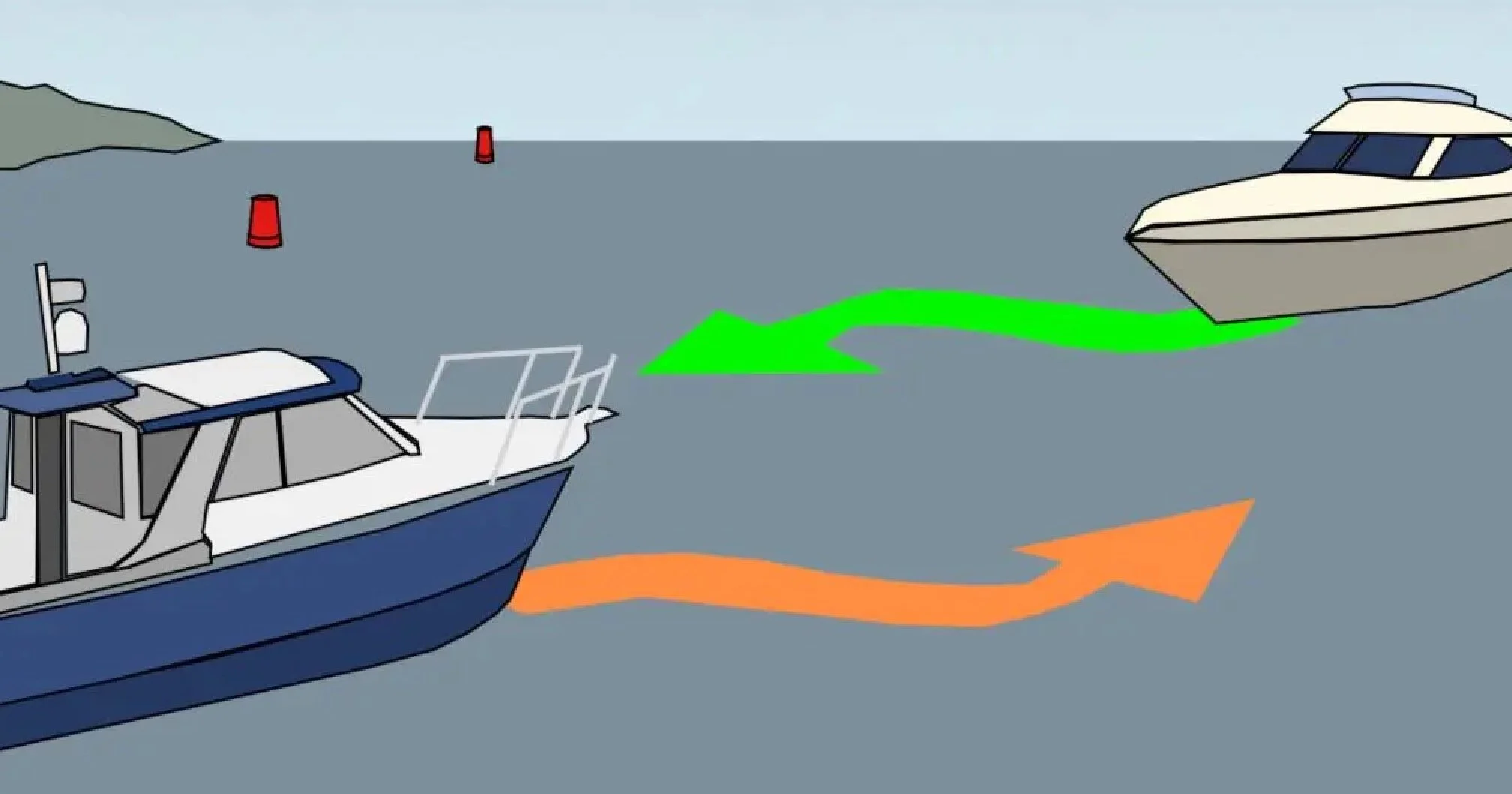
The stand-on vessel holds course and speed. That's the hard part — you keep doing exactly what you're doing so the other captain can read you and plan around you. The give-way vessel is the one that acts: turn early, turn wide, slow down, make your intentions so obvious there's nothing left to guess. Early and substantial beats late and subtle every single time.
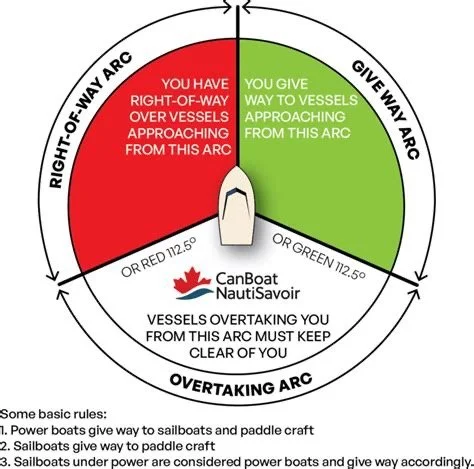
Picture three arcs around your hull. Off your bow and starboard side — where your green light shines — is your give-way arc: boats in there, you yield to them. Off your port side — your red light — is your stand-on arc: you hold your line. And the whole wedge behind you is the overtaking arc: anybody coming up from back there has to keep clear of you.
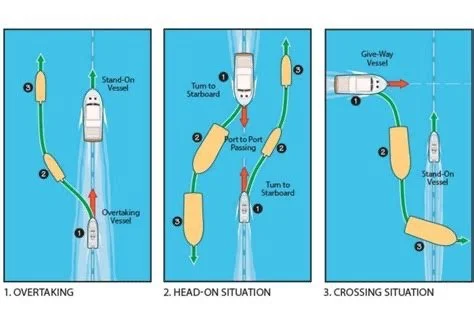
The three situations, power boat to power boat
Meeting head-on: neither of you is stand-on. Both alter course to starboard and pass port to port — same as meeting a truck on a two-lane road. Left shoulders pass left shoulders.Crossing: the boat on your starboard side — off your right — is the stand-on vessel, and you give way. Slow down or steer behind it; don't try to beat it across the bow. (There's a night mnemonic for the same idea: if you see red, give way ahead.)Overtaking: the boat coming up from behind always gives way. Always. It doesn't matter what kind of boat it is — even a sailboat running down a powerboat has to keep clear when it's the one doing the passing. If you're the one being overtaken, hold your course and let them go around.
When it's not two power boats: the pecking order
All of that assumes two power-driven boats. The moment other vessel types enter the picture, power boats sit near the bottom of the ladder. From the top down, you give way to a vessel not under command, a vessel restricted in its ability to maneuver, a vessel constrained by its draft, a boat actively fishing with nets or lines out, and a boat under sail. A power-driven boat yields to just about everyone.
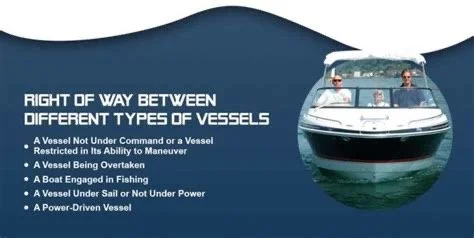
Out here that's not academic. Give the shrimpers with their nets down a wide berth — they're restricted the second that gear is in the water — and don't crowd a sailboat working the wind. One catch worth knowing cold: a sailboat running its engine is legally a power boat, and gives way accordingly.
Say it with the horn
When it's tight and you need to be understood, use your horn. One short blast means "I'm altering to starboard." Two short blasts, "I'm altering to port." Three, "I'm backing down." And five or more rapid blasts is the one every captain should know cold: danger — or "I don't understand what you're doing." If you hear five, stop guessing and sort it out before anybody gets closer.
The rule that beats every other rule
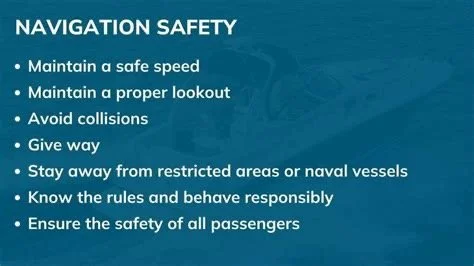
Here's the part that outranks every diagram on this page: the Rules of the Road do not give anyone the right to cause a collision. Every source says it a little differently, but they all land in the same place — take whatever action it takes to avoid hitting somebody, stand-on or not. Keep a proper lookout by sight and hearing, hold a safe speed for the conditions, and assume the other guy has no idea what he's doing. Being technically in the right is cold comfort at the insurance adjuster's office. Being right doesn't buff out fiberglass.
Be a Better Boater: Take a Class
Reading about it is one thing; a day in the classroom is another. Two good options sit right in our backyard. The U.S. Coast Guard Auxiliary runs its Boat America recreational safety course at the Daphne Fire Training Center, and the last session in our area this season is Saturday, August 15 — 8 AM to 4 PM, bring your lunch. It's $45 with textbook and materials included, and the course is NASBLA-approved. For any Alabama resident 12 and older, it's the class that makes you eligible to qualify for the state boater's license to run a vessel or PWC. Reserve a seat with Michael Reagan at (901) 828-8280 or sdmwr070197@gmail.com — Daphne Fire Training Center, 25250 Bailey Yelding Jr. Drive, Daphne, AL 36526.
Ready to go further than a weekend refresher? Boat Tutors — The Captain School of Gulf Shores is the real deal, run by Captain Jack Sanzalone with 43 years on the water and 30 in the Navy. They teach the whole ladder — from a Nautical Knowledge "101" class for new boaters all the way up to professional mariner tickets: the OUPV / 6-Pack, Master 100- and 200-Ton, assistance-towing endorsement, marine radio operator's permit, and STCW basic training. They cover Alabama, Mississippi, and Northwest Florida, and will build custom training for a department or crew. If you've ever thought about turning your time on the water into a license, that's where you start — boattutors.com or (941) 268-6622.Learn the two roles, run them till they're second nature, then give way early and often. That's not timid — that's being the captain everybody else on the water is glad to see coming. See you on the water.
Dig deeper
BoatUS Foundation — Rules of the RoadDiscover Boating — Boating Right of WayNW Boat School — Right-of-Way Rules ExplainedBoat Tutors — The Captain School of Gulf ShoresRules of the road are national (U.S. Inland Rules & COLREGS). Nothing here replaces the official navigation rules or a licensed captain's judgment — when in doubt, slow down and give way.