
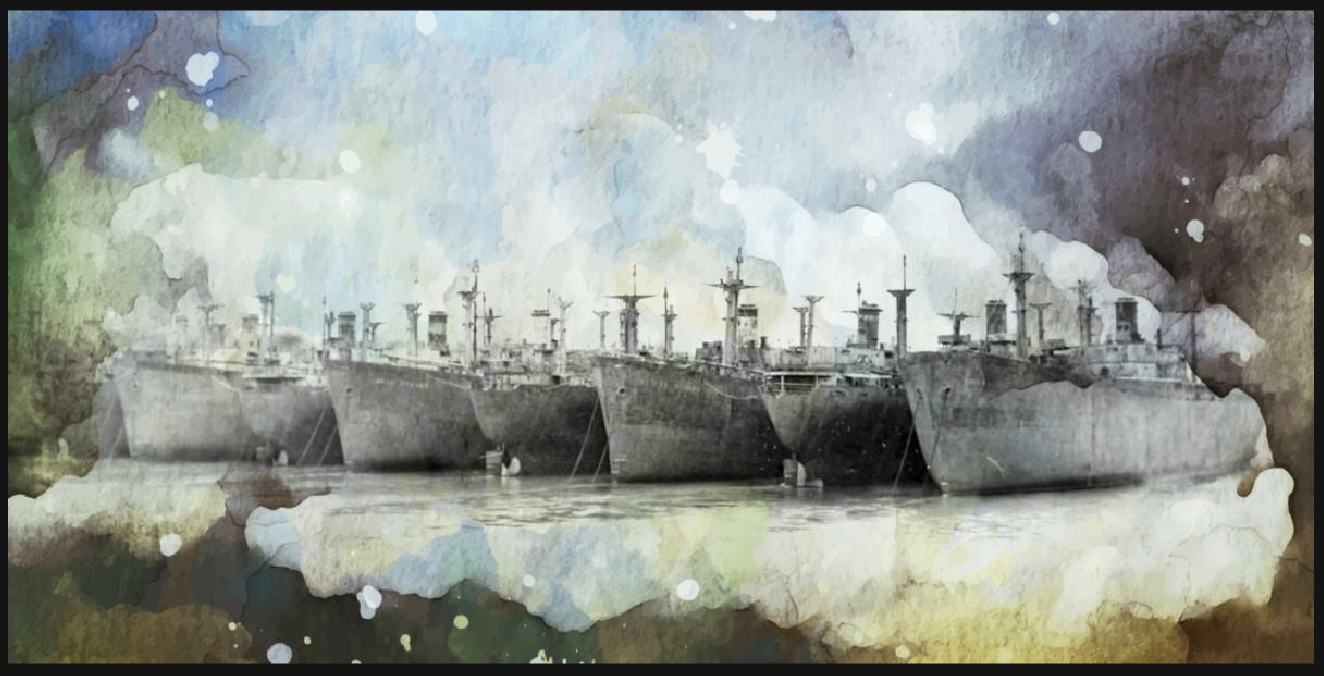
It's Halloween season along the Gulf Coast, and our local legends hold up against any theme-park haunt. This year we're skipping the jump scares and following the stories that live on the water — phantom ships, keepers who never left their lights, and soldiers still standing watch on brick forts built to guard the passes. Every place on this list sits at the edge of a bay or a pass. Most of them you can see from the helm.
The Phantom Ship of Mobile Bay
One of the oldest stories on the Bay tells of the Phantom Ship of Mobile Bay — a glowing cotton schooner said to have vanished in a sudden storm, her crew lost to the waves. Some still claim to see her lights moving low through the fog.
The schooner is pure legend. The river that feeds the Bay holds a ghost story with a real disaster underneath it. On March 1, 1858, the steamboat Eliza Battle left Demopolis loaded with passengers and more than 1,200 bales of cotton, bound down the flooded Tombigbee for Mobile. Somewhere below Demopolis, in the middle of an ice storm, the cargo caught fire. The flames burned through her tiller ropes, the pilot lost the helm, and she drifted into flooded timber while passengers went into freezing water. Dozens died. Fishermen on that stretch of river have said for generations that on cold winter nights a fog bank rolls downstream with a burning steamer inside it, and voices calling from the fire. She never made Mobile. Some folks believe she's still trying.
Fort Morgan: The Barracks and the Woman on the Walls
Fort Morgan has guarded the mouth of Mobile Bay since the 1830s. In August 1864 the Union fleet forced its way past her guns, and the garrison was soon forced to surrender. Thousands of soldiers lived, worked, and died inside those walls over the next eighty years.
The old barracks carry the fort's best-known story. Records show a prisoner hanged himself there in 1917, and visitors still report hearing a man cry late at night. Others describe footsteps in empty casemates, a tap on the shoulder with no one behind them, and pipe smoke drifting through corridors where nobody is smoking. The most-reported figure is a young woman, said to have been attacked at the fort in the 1800s, who still walks the grounds looking for the man who did it.
The fort's quietest story is its saddest. In the 1830s, during the forced removal of the Creek Nation, some 3,500 Muscogee people were held at Fort Morgan. Ninety-three of them died there and were buried somewhere on the property. Nobody knows where.
And then there's the gold. Whispers of Jean Lafitte's buried treasure have persisted from Perdido Key to Fort Morgan for two centuries. The privateer allegedly anchored in Mobile Bay and stashed his take near the fort — some say near the tricky entrance to Perdido Bay. Historians who have read the Lafitte brothers' own letters will tell you privateers spent money; they didn't bury it. Nobody has turned up a doubloon. People keep digging anyway.
Fort Gaines and Massacre Island
Across the mouth of the Bay, Dauphin Island started its recorded history with a bad omen. When Pierre Le Moyne d'Iberville's men came ashore in 1699, they found about 60 human skeletons on the beach and named the place Massacre Island. Historians now think a storm had opened an old burial mound. The French renamed it for the Dauphin around 1707, but the story stuck.
The Dauphin Island Museum's longtime director has told reporters that people still hear drums and singing at night near the shell mounds on the north shore, and some report white lights rising from the mounds on certain dates.
Fort Gaines, begun in 1821 on the island's east end, is said to be haunted twice over — by soldiers, and by the women of their families. One island resident tells of driving to the turnaround behind the fort on a crisp fall night under a half moon and seeing a woman in a long, flowing skirt standing alone on the ramparts, looking out at the Gulf. Visitors describe men in period uniform beneath the bastions, sudden cold spots, and low whispers in the dark recesses of the walls.
The two forts face each other across the Bay entrance, and the Mobile Bay Ferry runs between them — about 40 minutes across. Tickets are first come, first served at the landing, only one boat runs in the off-season, and the ferry doesn't cross in bad weather. Check the schedule before you go.
Pensacola Lighthouse: The Keeper's Wife
Pensacola's first lighthouse keeper was Jeremiah Ingraham. His wife, Michaela, learned the work alongside him. Legend says that in 1840 she killed him and took over the light herself, keeping it until 1855.
Here's the wrinkle. The tower standing on the bluff today was first lit in 1859, at a different spot from the original light, nearly two decades after Jeremiah died. That hasn't slowed the stories down one bit. Visitors report footsteps climbing the stairs, a glow in the top window, and objects moving in the keeper's quarters. Emmett Hatten, who grew up in the lighthouse in the 1930s and '40s while his father kept the light, said he often heard someone breathing in the lantern room. He would call out. Nothing ever answered. When the Ghost Hunters crew investigated in 2009, they left convinced the place was haunted, and the lighthouse now runs its own ghost hunts.
Fort Barrancas: The Tunnel to the Water Battery
Next door, Fort Barrancas sits on the bluff above the Spanish water battery, built in 1797 to skip cannonballs across the bay into ships at the waterline. The brick fort above went up between 1839 and 1844, and a tunnel connects the two. In January 1861, U.S. troops spiked the guns and abandoned Barrancas for Fort Pickens across the pass. Pensacola's own tourism office will tell you the fort's corridors are still occupied.
Both the lighthouse and Barrancas sit inside Naval Air Station Pensacola, and you can only get there by road. As of this spring the base's West Gate, at the south end of Blue Angel Parkway, opens to visitors 9 AM–3 PM daily. Anyone 18 or older needs a REAL ID or passport, and boats and boat trailers are not allowed. Public access closed for weeks earlier this year during a funding lapse, so check NAS Pensacola's status before you make the drive.
Fort Pickens: Geronimo's Island and Bastion D
Fort Pickens guards Pensacola Pass from the western tip of Santa Rosa Island — 21.5 million bricks laid largely by enslaved workers. On October 25, 1886, sixteen Apache men, Geronimo among them, were ferried across the bay as prisoners of war. Pensacola businessmen had lobbied to bring them there as a tourist draw, and it worked: on one recorded Sunday, 459 sightseers came out to look at them.
Thirteen years later, the fort's history turned violent. Before dawn on June 20, 1899, soldiers found fire in the casemates near the sally port, spreading toward a magazine holding 8,000 pounds of powder. Second Lieutenant Robert H. C. Kelton fought it with 60 men, then pulled them back before the magazine went. The blast tore out all of Bastion D and threw debris a mile and a half. It killed Private Earle F. Welles, who now rests across the bay at Barrancas National Cemetery. The cause of the fire was never determined. The gap in the wall is still there.
People say voices follow visitors through the fort's long brick corridors. Walk past the gap at Bastion D late in the day and you'll understand why the story stuck.
Fort McRee: The Castle Built on Sand
The one most visitors never see sits on the far eastern tip of Perdido Key. Fort McRee was finished around 1840 on a sandbar called Foster's Bank to cover Pensacola Pass alongside Pickens and Barrancas. On November 22, 1861, Union guns at Fort Pickens and warships offshore opened on the Confederate garrison there. By the second day, McRee's guns had gone silent. The Confederates abandoned it the next spring, and storms have been taking it apart ever since.
Today there's almost nothing left — a few battery ruins half-buried in sand, no facilities, no crowd. The usual way in is by boat. Nobody seems to have written down a proper ghost story for McRee, which might be the eeriest thing about it. Drop a hook nearby at dusk, kill the music, and listen.
Go See for Yourself
Head to Fort Morgan about 30 minutes before sunset and stay until full dark. Watch low over the water for faint lantern lights moving where no boat should be. Bring bug spray, closed-toe shoes, and a windbreaker for the cool breeze off the Bay.
The forts are easy to find. The waterfront stops between them — where to tie up, what to order, what the approach looks like when the light goes — take a captain who's run them. That's what we put in The Dispatch every week. Sign up at DocksideGuide.com and get it in your inbox.